Property owners in Pakistan are obliged to pay tax for commercial and residential properties under urban immovable property tax acts of a certain province. However, all the tax is levied on the value of the property and its location area. Paying taxes is important for property owners otherwise a tax lien will be implied by the local government or the property will be foreclosed. If anyone finds a way to get exemption from paying property tax, they may have to face serious troubles in the future by FBR (Federal Board of Revenue).
What's changed for 2026-27: the Finance Act 2026 made three significant changes to how property transactions are taxed at the federal level. Section 7E — the annual 1% tax on idle property valued above Rs 25 million — has been abolished outright from 1 July 2026, along with the 7E certificate requirement. The buyer's advance tax under Section 236K and the seller's advance tax under Section 236C have both been simplified into flat rates for active filers, replacing the old multi-tier slab systems. The sections below reflect these current rates — jump to Types of Property Tax if you just need the numbers.
What is a property tax?
Property tax refers to the amount you pay because of property owning, buying, or selling. This includes sales tax and maintenance tax. The sales tax is paid at the time of property purchase. Hence, this tax can be in form of stamp duty, town tax, withholding tax, registration fee, and capital value tax according to the taxation rules of the province you are living in. You have to pay maintenance tax every year. People who are planning to buy property must keep in mind certain taxes they have to pay.
How does Property Tax System work in Pakistan?
Pakistan calculates and collects property tax as per the Urban Immovable Property Tax act since 1958 both for commercial and residential properties. However, all the taxes are collected by urban local governments. Whether you are a plot owner, homeowner, or commercial property owner, the tax is levied on the annual rental value of your property according to Immovable property tax acts. However, the property tax rates vary as per the province. The rental value of the property does not mean the actual rental value but an estimated rental amount on which your property can be rented out.
Punjab Property Tax
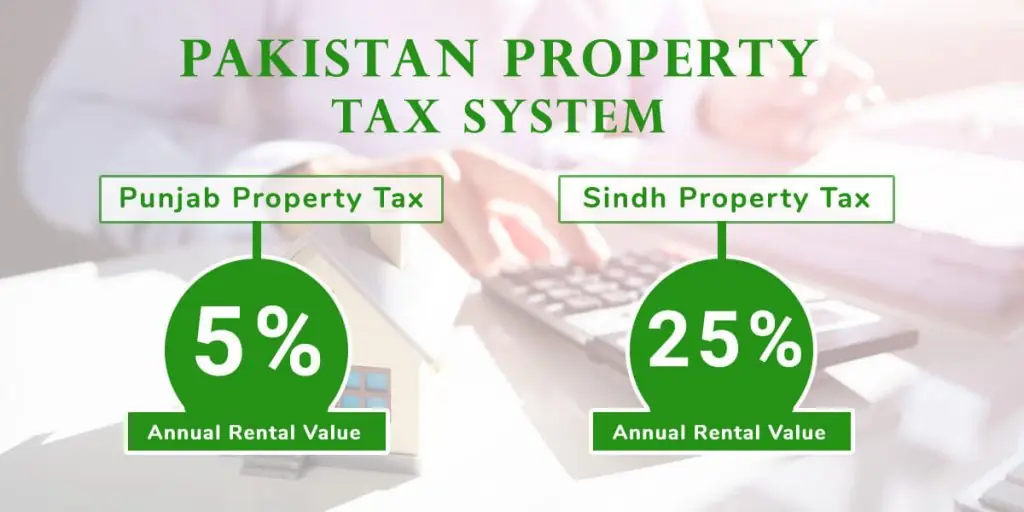
According to Excise and Taxation department of Punjab, the tax is levied on 5% annual rental value of a property. The rental value is determined according to the property location, size, and category.
Sindh Property Tax
According to Excise and Taxation department of Sindh, the tax is levied on 25% of the property annual rental value.
How to Calculate Property Tax in Pakistan?
Property tax calculation requires considerable knowledge and care. The excise, taxation & Narcotics control department of all provinces has made the calculation simple, fast, and efficient by introducing online calculators. Also, you can make calculations manually with the help of valuation tables.
Check Property Tax Online in Pakistan
Now, you can calculate and check property tax online in Pakistan with more accuracy. You can check the property tax in Punjab, property tax Lahore, Sindh, and other provinces. However, the online property check calculator allows you to evaluate tax value while sitting at home. Here are the steps to check property tax online.
See More:
How to Check Property Tax Online in Punjab?
Need help applying this to your project?
Message our research desk on WhatsApp — we'll point you to the right society, scheme or professional.
WhatsApp +971 52 804 3509- Open the official website of excise, taxation & Narcotics control department. Find and select the category to which your property belongs
- Choose from the residential and commercial category
- Select type of building use
- Mention the Covered area of your property
- Select from self-used or rented options
- Choose location Main Road or off-road (usually mentioned in commercial property)
- Select new calculator to know the tax according to current rates
How to Check Property Tax Online in Sindh?
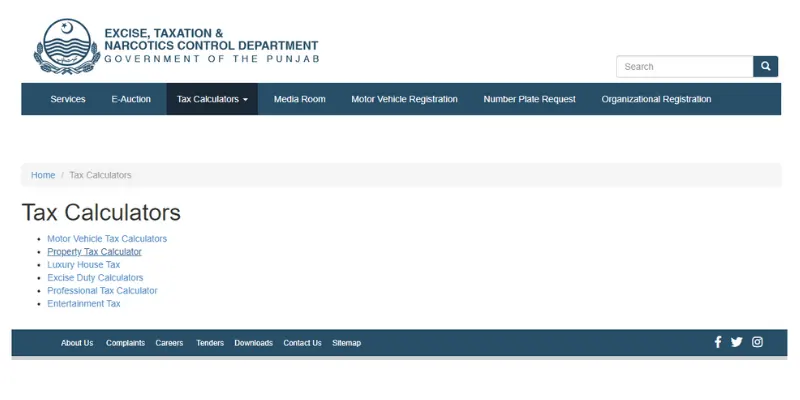
- Open the official website of excise, taxation & Narcotics control department Punjab. https://excise.punjab.gov.pk/property_tax
- Select Tax Calculator from the menu
- Find and select the category to which your property belongs
- Choose from the residential and commercial category
- Select type of building use
- Mention the Covered area of your property
- Select from self-used or rented options
- Choose location Main Road or off-road (usually mentioned in commercial property)
- Select new calculator to know the tax according to current rates
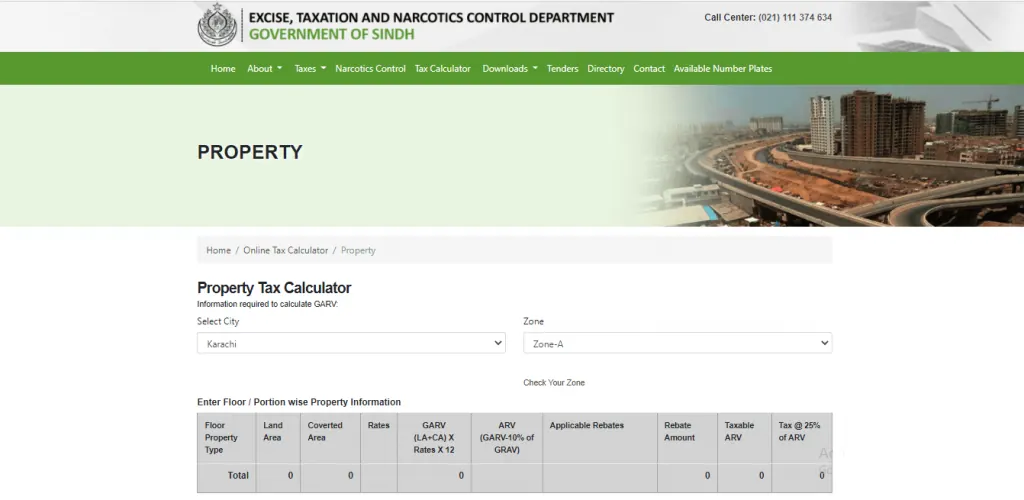
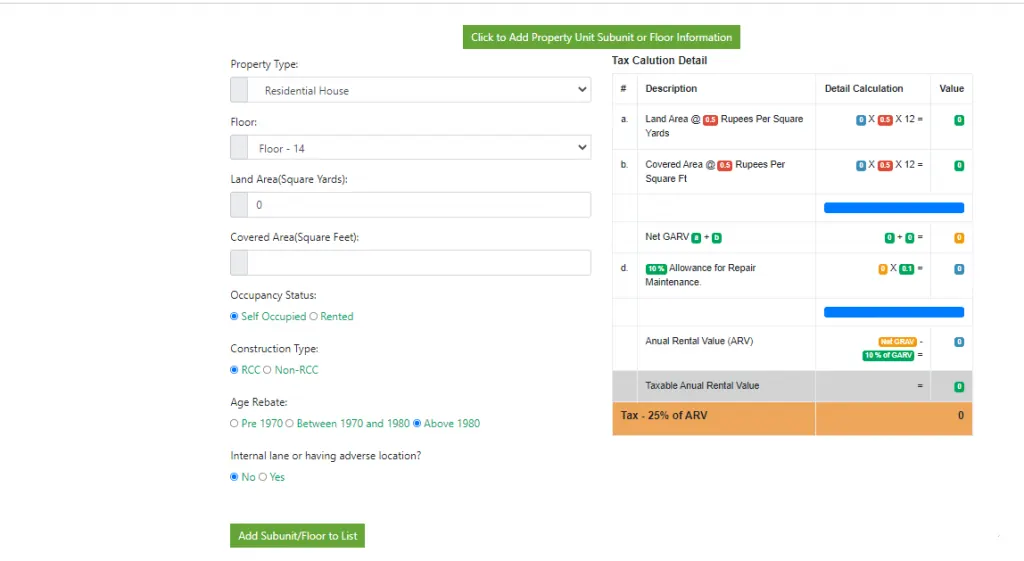
Property Calculation through Valuation Table
You can also check the levied tax on your residential and commercial property through the valuation table issued by the excise & taxation departments of provincial governments. However, these tables are updated regularly according to the provincial property value measures. However, the same property calculation formula is applied in each province.
First, you should have the annual rental value of your property. The number to calculate property value differs according to property type and size. You can calculate property tax both for commercial and residential assets with the help of valuation tables. However, the tables are different for both categories. Find the category and your property area from the valuation table. Calculate property tax in the following ways!
- Get the total land area of your property
- Per square yard rent prescribed in valuation table
- (Total Land Area of a Property) x (Per square yard rent prescribed in Valuation Table) = A
- (Total Covered Area of a Property) x (Per square foot rent prescribed in Valuation Table) = B
- Add A and B to get the gross annual rental value of your property (A + B) x 12 = Gross Annual Rental Value (GARV)
- GARV – 10% of GARV = Annual Rental Value (or annual value)
Which Properties are exempted from Tax in Pakistan?
Some properties that are exempted from tax in Pakistan includes:
- Residential properties that are less than 5 Marla (In Lahore Bahria town, Gulberg, and other posh areas, the property tax is also applied for houses less than 5 Marla.)
- Properties not exceeding the annual rental value of PKR 4,320.
- A single house with PKR 6,480 rental value
- Properties owned by orphans, widows, and disabled persons with up to PKR 12,150 annual rental value
- Government buildings & welfare centers
- Mosques and other religious buildings
- Libraries, schools, boarding, parks, and hospitals are tax-free
How to Pay Tax in Pakistan?
You can pay property tax in Pakistan in multiple ways that include!
Pay Property Tax Online
FBR is providing online tax payment facility for the ease and convenience of people. You can pay your tax through your online bank account. For this, you need to follow the following steps!
- Go to the official website of FBR
- Get your PSID number from the website
- Log in to your bank account
- Go to bill payment, select FBR and enter your PSID to pay tax
- After paying tax, you will receive a confirmation computerized receipt through email or SMS
Pay Property Tax with ATM
- Go to the official website of FBR
- Get your PSID number from the website
- Go to any ATM
- Go to bill payment, select FBR and enter your PSID to pay tax
- After paying tax, you will receive a confirmation computerized receipt through email or SMS
Provincial Tax Calculation Department
Every provincial government has its own tax collection departments. You can go to those departments and pay tax easily by following the simple procedure.
Pay Tax via Banks
You can also easily pay property tax in banks by generating a property challan online and then paying the tax.
Types of Property Tax in Pakistan
In Pakistan, there are multiple types of property taxes that are imposed on you while making a sale or purchase of any property. The main property tax types in Pakistan are as follows!
Capital Value Tax (CVT)
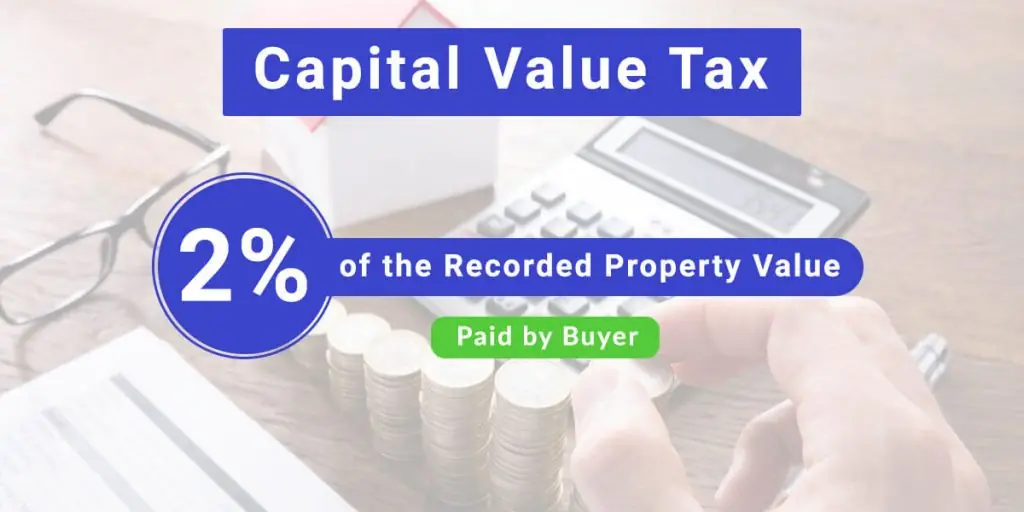
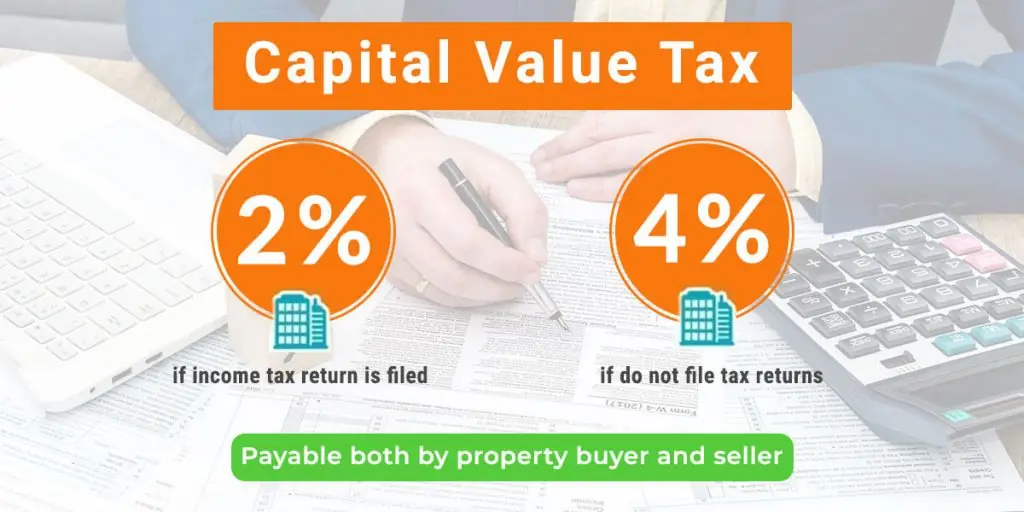
CVT is a provincial-level tax that can apply on gifted, exchanged, or certain non-sale property transfers, generally around 2% of the recorded value, though the exact treatment now varies by province and transaction type. Because CVT rules shift most budget cycles, confirm the applicable rate for your specific transaction type with your provincial excise & taxation department before signing anything — don't rely on a flat 2% figure without checking.
Advance Withholding Tax — Sections 236K & 236C (updated for Finance Act 2026-27)
These are the two advance taxes collected at the time of transfer, and both were restructured in the 2026-27 budget to replace the old multi-tier slabs with flat rates for filers:
- Section 236K (paid by the buyer): a flat 1.25% of the higher of the declared value or the FBR-notified value, for buyers on the Active Taxpayer List (ATL), on property values up to Rs 50 million — slightly higher slabs apply above that threshold. Non-filers face substantially higher rates, up to around 18.5% on high-value purchases.
- Section 236C (paid by the seller): a flat 2.75% for ATL filers and overseas Pakistanis (POC/NICOP holders can access filer rates without filing a Pakistani return), versus roughly 11% for non-filers. This tax is collected regardless of profit and counts as a minimum liability if you sell within a year of purchase.
Being an active filer at the time of transfer is now the single biggest lever on your total tax bill — the gap between filer and non-filer rates on both 236K and 236C is wide enough to change a deal's economics. Always verify current ATL status and the FBR-notified valuation for the specific property before agreeing a price.
Capital Gains Tax (CGT) — depends on when you bought
The Finance Act 2024 overhauled CGT on property, and the rules that apply now depend entirely on your acquisition date:
- Property acquired on or after 1 July 2024: a flat 15% CGT on the profit for active filers, with no holding-period relief — you pay 15% whether you sell after one year or ten. Non-filers pay a minimum of 15%, rising depending on the property's value and their overall income.
- Property acquired before 1 July 2024: the older holding-period slab system still applies to these properties, in every later tax year. Under it, CGT for filers reduces the longer you hold, reaching 0% after 2 years for flats/apartments, 4 years for constructed houses, and 6 years for open plots.
Section 236C collected at the point of sale is adjustable against your final CGT liability when you file your annual return — it isn't an extra tax on top, but an advance against it. As a responsible citizen, paying property tax is your obligation to make the economy of the country stronger; hiding taxation details or trying to avoid it exposes you to penalties and lawful action from FBR.

Section 7E — abolished from 1 July 2026
Until this year, Section 7E deemed that any immovable property with a fair market value above Rs 25 million earned its owner a notional 5% rental income, taxed at 20% — working out to roughly 1% of the property's value, payable annually, whether or not the property was rented, occupied, or generating any income at all. Owners also needed a 7E exemption certificate to transfer their property. Both the tax and the certificate requirement were removed by the Finance Act 2026, effective 1 July 2026. If older guides or forms you come across still mention 7E, that requirement no longer applies.